Vestibular Unesp · Linguagens
Questões de Inglês da Unesp
44 questões de Inglês das provas da Unesp de 2019 a 2027, com os anos misturados. Toque na alternativa para conferir na hora.
Questões 1 a 20 de 44
Questão 21 · Unesp 2025
If you're a chocoholic you may have noticed that your habit has lately become more expensive. The price of cocoa began creeping up in the second half of 2022. Since then it has doubled, reaching an all-time high in January 2024. That steep rise spells trouble for the chocolate business and sweet-toothed consumers alike.
Graph 1
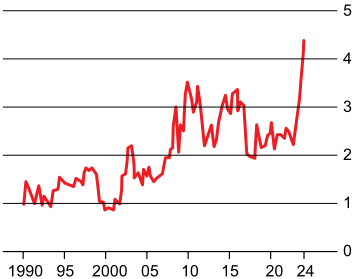
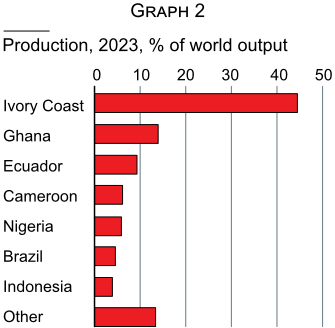
Climate patterns are partly to blame for rising costs. Cocoa is mostly produced by small farmers in West Africa. Ghana and Ivory Coast grow about 60% of the world's crop. Last season, in 2023, the El Niño weather pattern led to unseasonably high temperatures and rainfall that ravaged crops. Total rainfall in Ivory Coast's cocoa-growing areas in 2023 was the highest in 20 years, according to Gro Intelligence, a data firm.
This year El Niño has brought severe drought to the cocoa farms, reducing production further. ING, a bank, estimates that this year the gap between global production and consumption will be at its widest since at least 2014. Extreme weather patterns have hit other commodities, too. Droughts in Thailand and India are affecting rice plantations. Torrential rain in Brazil, the world's biggest sugar exporter, has affected its exports. Besides, other price pressures are specific to the cocoa industry. Swollen-shoot virus and black-pod disease - killers of cocoa trees - spread across Ghana and Ivory Coast during heavy rainfall last year. Tropical Research Services, a research company, estimates that by the end of 2023 the swollen-shoot virus had infected around 20% of Ivory Coast's cocoa trees.
(www.economist.com, 28.02.2024. Adaptado.)
The aim of the text is to
Fonte: Unesp 2025 · Texto-base: (www.economist.com, 28.02.2024. Adaptado.) · Pedir remoção ou avisar erro
- A)
explain the reasons that have led to the escalation of cocoa prices.
- B)
convince consumers to reduce chocolate intake to force price drop.
- C)
establish climate change as the only cause of cocoa production crisis.
- D)
present opportunities for countries to expand their cocoa exports.
- E)
show that chocolate producers intend to increase their profits even more in 2025.
Ver resposta
Resposta: alternativa A
Gabarito oficial da banca.
- A)
Questão 30 · Unesp 2027
The European Union-Mercosur agreement is a big deal in the world of geoeconomics
The European Union (EU) and Mercosur, a bloc of South American countries, first started negotiating their trade deal last century. That the two blocs signed that deal in January 2026, after more than 25 years of negotiations, highlights how things have changed. The United States is retreating from globalization and raising tariffs. Chinese competition threatens businesses in both Latin America and Europe, and countries are increasingly obsessed with guaranteeing secure supplies of critical raw materials, of which Latin America has plenty. Anticipating such challenges, the EU and Mercosur completed their negotiations in 2024, though agreeing to approve the deal took Europe another year. On January 17 th, 2026 the two sides formally sign it at a ceremony in Paraguay.
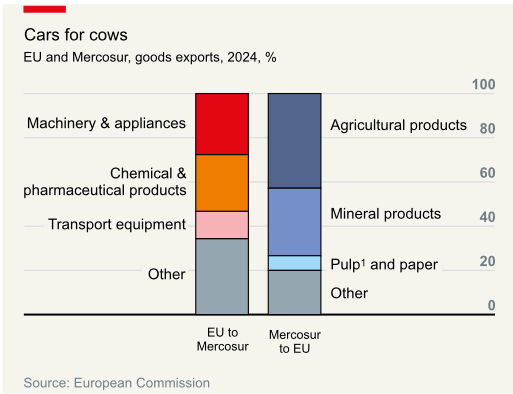
1 pulp: a cellulosic material mainly from wood used in making paper.
The quarter-century negotiating delay is the fault of protectionist lobbies on both sides of the Atlantic, especially European farmers, who fear a flood of cheap beef and sugar. Some called the deal "cows for cars", suggesting the winners would be Latin American farmers and European industry. Predictably, France led the opposition: it stood firm to the very end on January 9 th, 2026, when it was joined by Poland and a few smaller EU states in opposing the deal in an internal EU vote-count. Germany and other northern European export powerhouses were more enthusiastic, as was Spain, with its close ties to Latin America. The pact won the support of a "qualified" majority of EU countries, as weighted by population, after a raise in subsidies for farmers helped induce Italy to switch sides. It opens up markets in four longstanding Mercosur members: Brazil, Argentina, Paraguay and Uruguay. Venezuela has been suspended from the bloc and is thus not included. Bolivia, the newest member, could join the trade agreement in the coming years.
The deal is a major event in what has come to be called "geoeconomics", or the interaction between geopolitics and the economy. It is the biggest element of a wider attempt to strengthen ties with Latin America and diversify European trade and supply chains. Such ties help develop Latin American industries that the EU can count on if others cut it off, such as critical raw-material extraction and refinement. Rejecting Mercosur at the request of domestic farmers would have been an own goal for Europe.
(www.economist.com, 11.01.2026. Adaptado.)

No trecho do terceiro parágrafo "Rejecting Mercosur at the request of domestic farmers would have been an own goal for Europe", a expressão sublinhada, no contexto em que se insere, equivale, em português, a
Fonte: Unesp 2027 · Texto-base: (www.economist.com, 11.01.2026. Adaptado.) · Pedir remoção ou avisar erro
- A)
um gol contra.
- B)
uma meta atingida.
- C)
um objetivo próprio.
- D)
um gol de empate.
- E)
um gol decisivo.
Ver resposta
Resposta: alternativa A
Gabarito oficial da banca.
- A)
Questão 30 · Unesp 2024
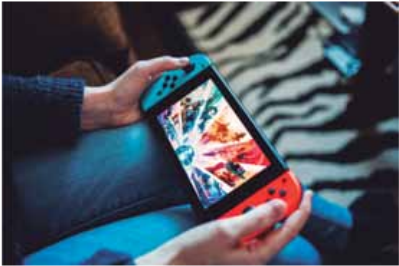
The benefits of computer games in education are clear. They engage students, improve problem-solving skills, enhance creativity and imagination, allow for personalized learning, remote learning, learning on demand, and contacting peers around the world. With the increasing use of technology in schools, it is essential that teachers explore the potential benefits of computer games and incorporate them into their teaching methods. Doing so can create a more engaging and effective learning environment for their students.
(Ruby Butz. https://gamingrespawn.com, 23.03.2023. Adaptado.)
According to the text, one of the advantages of computer games in education is:
Fonte: Unesp 2024 · Texto-base: (Ruby Butz. https://gamingrespawn.com, 23.03.2023. Adaptado.) · Pedir remoção ou avisar erro
- A)
behaviour management tools for teachers.
- B)
enhancement of problem-solving skills.
- C)
doubtful teaching methods.
- D)
friendly learning environment.
- E)
face-to-face contact among peers.
Ver resposta
Resposta: alternativa B
Gabarito oficial da banca.
- A)
Questão 29 · Unesp 2027
The European Union-Mercosur agreement is a big deal in the world of geoeconomics
The European Union (EU) and Mercosur, a bloc of South American countries, first started negotiating their trade deal last century. That the two blocs signed that deal in January 2026, after more than 25 years of negotiations, highlights how things have changed. The United States is retreating from globalization and raising tariffs. Chinese competition threatens businesses in both Latin America and Europe, and countries are increasingly obsessed with guaranteeing secure supplies of critical raw materials, of which Latin America has plenty. Anticipating such challenges, the EU and Mercosur completed their negotiations in 2024, though agreeing to approve the deal took Europe another year. On January 17 th, 2026 the two sides formally sign it at a ceremony in Paraguay.
1 pulp: a cellulosic material mainly from wood used in making paper.
The quarter-century negotiating delay is the fault of protectionist lobbies on both sides of the Atlantic, especially European farmers, who fear a flood of cheap beef and sugar. Some called the deal "cows for cars", suggesting the winners would be Latin American farmers and European industry. Predictably, France led the opposition: it stood firm to the very end on January 9 th, 2026, when it was joined by Poland and a few smaller EU states in opposing the deal in an internal EU vote-count. Germany and other northern European export powerhouses were more enthusiastic, as was Spain, with its close ties to Latin America. The pact won the support of a "qualified" majority of EU countries, as weighted by population, after a raise in subsidies for farmers helped induce Italy to switch sides. It opens up markets in four longstanding Mercosur members: Brazil, Argentina, Paraguay and Uruguay. Venezuela has been suspended from the bloc and is thus not included. Bolivia, the newest member, could join the trade agreement in the coming years.
The deal is a major event in what has come to be called "geoeconomics", or the interaction between geopolitics and the economy. It is the biggest element of a wider attempt to strengthen ties with Latin America and diversify European trade and supply chains. Such ties help develop Latin American industries that the EU can count on if others cut it off, such as critical raw-material extraction and refinement. Rejecting Mercosur at the request of domestic farmers would have been an own goal for Europe.
(www.economist.com, 11.01.2026. Adaptado.)
The excerpt from the third paragraph "or the interaction between geopolitics and the economy", in the context, presents
Fonte: Unesp 2027 · Texto-base: (www.economist.com, 11.01.2026. Adaptado.) · Pedir remoção ou avisar erro
- A)
an alternative idea.
- B)
a significant consequence.
- C)
a needless addition.
- D)
a contrast between two areas.
- E)
a clarification of a term.
Ver resposta
Resposta: alternativa E
Gabarito oficial da banca.
- A)
Questão 27 · Unesp 2023
World's happiest ranking goes to Finland for fifth year in a row
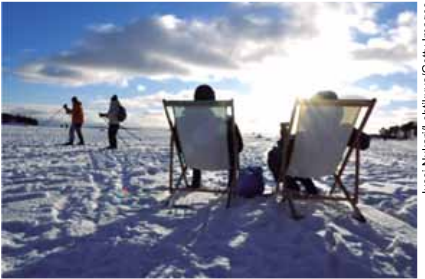
People enjoy sunny weather on the waterfront in Helsinki.
Finland was crowned the happiest country in the world for the fifth consecutive year, with a score significantly ahead of its peers in the World Happiness Report 2022 ranking, published by a body linked to the United Nations. However, the authors detected, on average, a long-term moderate upward trend in stress, worry, and sadness in most countries, as well as "a slight long-term decline in the enjoyment of life," they wrote.
The report uses global survey data to report on how people evaluate their own lives in more than 150 countries around the world, with the ranking based on a three-year average. Key variables that contribute to explaining people's life evaluations include healthy life expectancy, generosity, social support, freedom to make life choices, perceptions of corruption, and the gross domestic product per capita (an indicator that measures a country's economic output per person, that is calculated by dividing the total gross domestic product of a country by its population).
"World leaders should take heed," Jeffrey Sachs, director of the Center for Sustainable Development at Columbia University, said. "Politics should be directed as the great sages long ago insisted: to the well-being of the people, not the power of the rulers."
(Kati Pohjanpalo. www.bloomberg.com, 18.03.2022. Adaptado.)
According to the text, the World Happiness Report 2022
Fonte: Unesp 2023 · Texto-base: (Kati Pohjanpalo. www.bloomberg.com, 18.03.2022. Adaptado.) · Pedir remoção ou avisar erro
- A)
defines "enjoyment of life" as the most significant feeling that contributes to happiness.
- B)
is unreliable since it collected subjective data without scientifically established criteria.
- C)
showed that Finland is a surprisingly happy country although its score is not so high.
- D)
ranks countries based on global survey information on how people appraise their lives according to some key variables.
- E)
identified a slight increase in happiness among the 150 countries surveyed.
Ver resposta
Resposta: alternativa D
Gabarito oficial da banca.
- A)
Questão 25 · Unesp 2023
In March 2022, parts of Antarctica have been 40 ºC warmer than their March average The Concordia research station is one of the most inhospitable places on Earth. At 3,000 m above sea level on the Antarctic Plateau, the temperature rarely rises above -25 ºC even in the summer. In midwinter it can fall to around -80 ºC. The air is painfully dry, and fingers, toes and noses can freeze in minutes. The dozen or so crew, mainly French and Italian, who live and work in the station would normally venture out only for essential work. But Concordia has recently experienced a heatwave. On March 18th the temperature reached a high of -11.8 ºC - more than 40 ºC warmer than the average for this time of year.
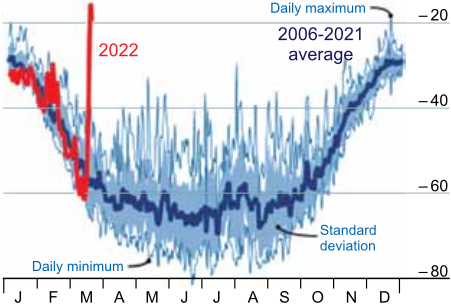

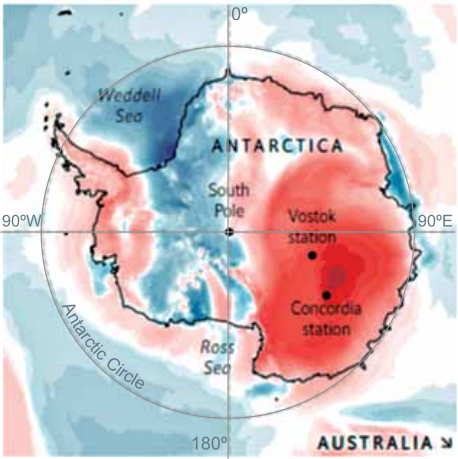
Similarly freakish weather was recorded across eastern Antarctica. Temperatures at the Russian-run Vostok research station rose to -17.7 ºC, more than 15 ºC above the previous record for March, set in 1967. Across the continent temperatures were 4.5 ºC higher than usual (though in recent days they have returned to a normal range).
Meteorologists have attributed the latest heatwave to an atmospheric "river" of warm, damp air blowing towards Antarctica from the Southern Ocean near Australia. It is difficult to know whether climate change is to blame for one-off weather events. But over the past 65 years or so there has been an increase in the number of "high temperature" days at Antarctic stations.
Most regions of Antarctica have been spared global warming. In the late 20th century, a large hole opened up in the ozone layer above the South Pole. This has a regional cooling effect, which has offset much of the heating caused by rising concentrations of greenhouse gases in the atmosphere. Temperatures on the continent rarely climb above freezing, which preserves its vast ice sheets (although rising sea temperatures do threaten some areas). Even in the recent surge, temperatures stayed well below zero.
(www.economist.com, 24.03.2022. Adaptado.)

According to the third paragraph, meteorologists associate the high temperature wave in Antarctica with
Fonte: Unesp 2023 · Texto-base: (www.economist.com, 24.03.2022. Adaptado.) · Pedir remoção ou avisar erro
- A)
a cycle of temperature peaks that happen every 65 years.
- B)
the melting of the snow, which creates temporary rivers across the continent.
- C)
an unusually hot summer in Australia.
- D)
the inflow of warm and damp winds coming from the ocean.
- E)
the abrupt weather changes in the Southern Ocean.
Ver resposta
Resposta: alternativa D
Gabarito oficial da banca.
- A)
Questão 22 · Unesp 2025
If you're a chocoholic you may have noticed that your habit has lately become more expensive. The price of cocoa began creeping up in the second half of 2022. Since then it has doubled, reaching an all-time high in January 2024. That steep rise spells trouble for the chocolate business and sweet-toothed consumers alike.
Graph 1
Climate patterns are partly to blame for rising costs. Cocoa is mostly produced by small farmers in West Africa. Ghana and Ivory Coast grow about 60% of the world's crop. Last season, in 2023, the El Niño weather pattern led to unseasonably high temperatures and rainfall that ravaged crops. Total rainfall in Ivory Coast's cocoa-growing areas in 2023 was the highest in 20 years, according to Gro Intelligence, a data firm.
This year El Niño has brought severe drought to the cocoa farms, reducing production further. ING, a bank, estimates that this year the gap between global production and consumption will be at its widest since at least 2014. Extreme weather patterns have hit other commodities, too. Droughts in Thailand and India are affecting rice plantations. Torrential rain in Brazil, the world's biggest sugar exporter, has affected its exports. Besides, other price pressures are specific to the cocoa industry. Swollen-shoot virus and black-pod disease - killers of cocoa trees - spread across Ghana and Ivory Coast during heavy rainfall last year. Tropical Research Services, a research company, estimates that by the end of 2023 the swollen-shoot virus had infected around 20% of Ivory Coast's cocoa trees.
(www.economist.com, 28.02.2024. Adaptado.)
O gráfico 1, "Price,
Carregando